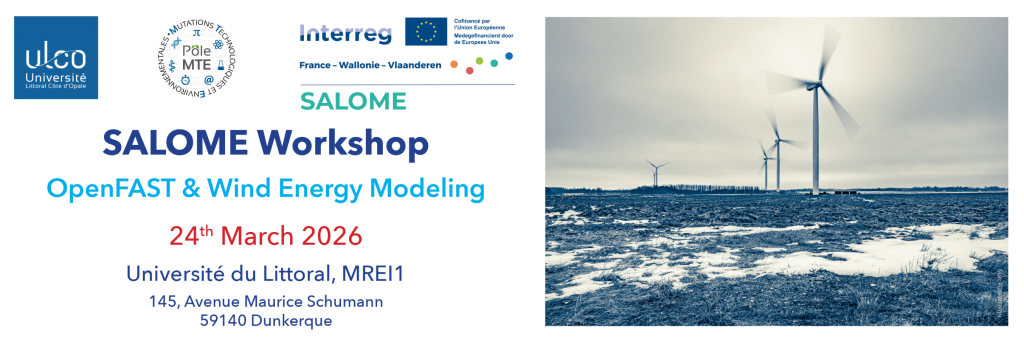
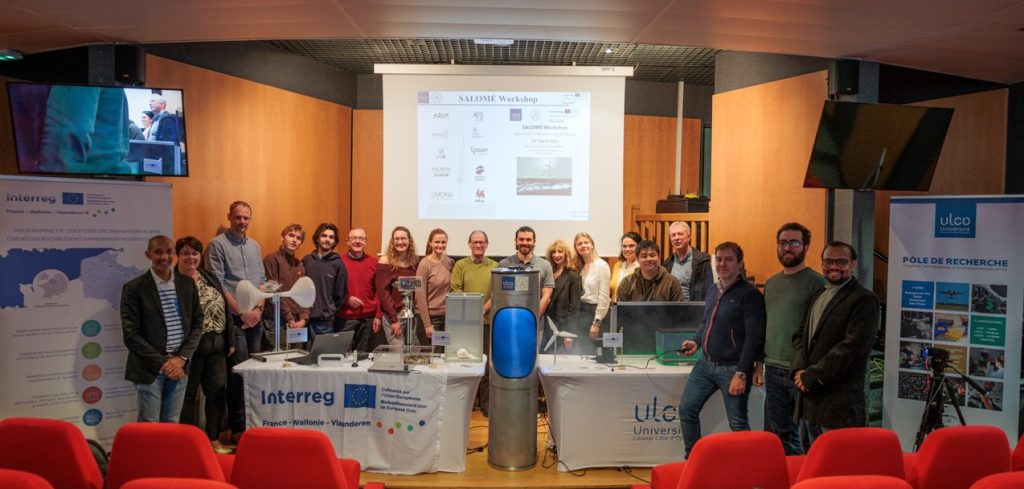


As part of the Interreg SALOME project, ULCO organized the “OpenFAST & Wind Energy Modeling” workshop on March 24, 2026, bringing together a cross-border consortium of researchers with diverse expertise.
This workshop focused on several key areas:
These exchanges facilitated the comparison of approaches and the consolidation of scientific advances in a field where multi-physics modeling is particularly complex. Indeed, the SALOMÉ project relies on a cross-border consortium bringing together researchers from several institutions: ULCO, the University of Mons, Polytech Mons, Ghent University, and the Multitel innovation center.
The strength of this collective lies in the diversity of its expertise:
This diversity is a real strength for the project… but it also poses a major challenge: how to effectively facilitate dialogue between specialists from such different fields?
It was precisely to address this challenge that an exceptional Animaconf, specially designed for researchers, was offered at the opening of the workshop. Far from being a simple popularization exercise, this presentation had a clear objective: “to facilitate mutual understanding within the consortium” by making fundamental concepts of fluid mechanics and atmospheric dynamics accessible. These concepts are essential for correctly understanding the behavior, performance, and sustainability of wind turbines. Through an interactive approach combining demonstrations, experiments, and audience participation, the ULCO Animaconf event fostered a common language among specialists from different disciplines.
This is a prime example of the ULCO Animaconf concept applied to researchers, enabling a large, multidisciplinary consortium to better grasp topics beyond their areas of expertise.